What should teams do now that Relay.app is shutting down?
Quick Answer: Relay.app announced on 16 July 2026 that it is shutting down. Free accounts and all their data are permanently deleted after 15 August 2026 at 23:59 PT, and paid accounts after 14 September 2026 at 23:59 PT, with paying customers keeping full access at no charge until that date. Export the workspace archive well before the deadline, because generation can take up to 24 hours and the emailed download link expires after 48; for the human-in-the-loop workflows Relay.app was usually bought for, Zapier and n8n are the only platforms evaluated here where a reviewer can edit an AI draft mid-run without custom development.
The timeline
Relay.app published its shutdown notice on 16 July 2026. The dates below come from Relay.app's own announcement; all times are 23:59 Pacific.
| Date | What happens |
|---|---|
| 16 July 2026 | New signups and free-to-paid upgrades turned off. Paid subscriptions cancelled automatically through Paddle. Data export opens. Existing workflows keep running. |
| 16 July to 14 September 2026 | Paying customers keep full access at no charge, plus an extra 25,000 steps and 10,000 AI credits per month. |
| 15 August 2026 | Free accounts "and all associated data will be permanently deleted". |
| 14 September 2026 | Paid accounts "and all associated data will be permanently deleted". Service ends. |
Annually billed subscribers receive an automatic prorated refund for the unused remainder of the period, processed through Paddle within five business days. The notice promises this for annual plans and does not explicitly extend it to monthly subscribers, although monthly billing also stopped on 16 July and paying customers keep the product free for the following 60 days.
Check your deadline on relay.app, not in the documentation. As of 28 July 2026 the announcement page on docs.relay.app states the two dates the wrong way round, giving paying customers the August deadline and free users the September one. The homepage notice is the correct version, and the documentation error runs in the direction that costs people data.
Getting the data out
Export is self-service from the dashboard: settings, then "Export workspace data". The archive contains one folder per Workflow, Sequence, MCP Server and Table, and each folder holds a rebuild prompt as a markdown file, run history as CSV, a JSON file describing the workflow structure, a JSON file per run, and a CSV of table data where applicable.
Three documented limits decide whether that export actually succeeds:
- Generation "may take up to 24 hours" for large workspaces.
- The emailed download link is live for 48 hours only.
- Run-history CSVs cap at 100,000 rows per export and are silently truncated beyond that.
Taken together, the practical last-safe-start is roughly three days before the deletion date, not the night before. Workflow screenshots are the one artefact the archive does not include; they are exported individually.
The most useful thing Relay.app says about portability is easy to miss. Its documentation states that the JSON export "is not perfectly transferrable to other tools without AI interpretation of the structure first" and that "it won't work through their native importers". The markdown build prompts, not the JSON, are the intended migration vehicle. That inverts the usual advice about exporting automation platforms, where the JSON is normally the asset.
Stored credentials and OAuth tokens for connected apps are deleted with the account, so any downstream app permissions granted to Relay.app end at deletion.
Where teams are going
Relay.app's distinguishing capability was not general automation; it was a run that pauses so a named person can approve, reject or edit an AI-drafted output, usually from Gmail or Slack. That editing step is where most replacements fall short. The table below reflects vendor documentation checked on 28 July 2026.
| Platform | Run pauses mid-execution | Reviewer can edit the draft | Where the reviewer acts | Entry price for the capability |
|---|---|---|---|---|
| Zapier | Yes, native Human in the Loop step | Yes, via a "Let Reviewer edit content?" setting | Zapier web UI; reviewers need a Zapier account | Professional, from $19.99/mo (not on Free) |
| n8n | Yes, Wait and Form nodes | Yes, through a form that returns edited values | A self-hosted or n8n-hosted form | Free self-hosted; Cloud from €20/mo |
| Gumloop | Yes, and it waits indefinitely | Approval gate on agent tool calls, not an edit field | Gumloop | $37/mo, unlimited seats |
| Activepieces | Yes, waitpoints shipped April 2026 | No, resumes with a boolean or button label | Slack, Gmail, Teams, Outlook, Discord, Telegram | Free up to 10 active flows |
| Make | No waitpoint; sleep caps at 300 seconds | Yes, but only in the Human in the Loop app | Make-hosted review URL | Enterprise, custom priced, and in closed beta |
| Lindy | Yes | Weaker than the above | Lindy | $29.99/user/mo (Sep 2026) |
Two findings are worth stating plainly. Make publicises a white-glove migration offer for Relay.app customers running through 14 September 2026, but its Human in the Loop app is documented as Enterprise-only and "currently in closed beta, only available to invited customers", so the capability a Relay.app team is migrating for cannot be self-served there today. And Activepieces pauses runs reliably but resumes with a yes or no; reproducing an edit step means hosting a web form and resuming through a webhook, which is a software project rather than a configuration change.
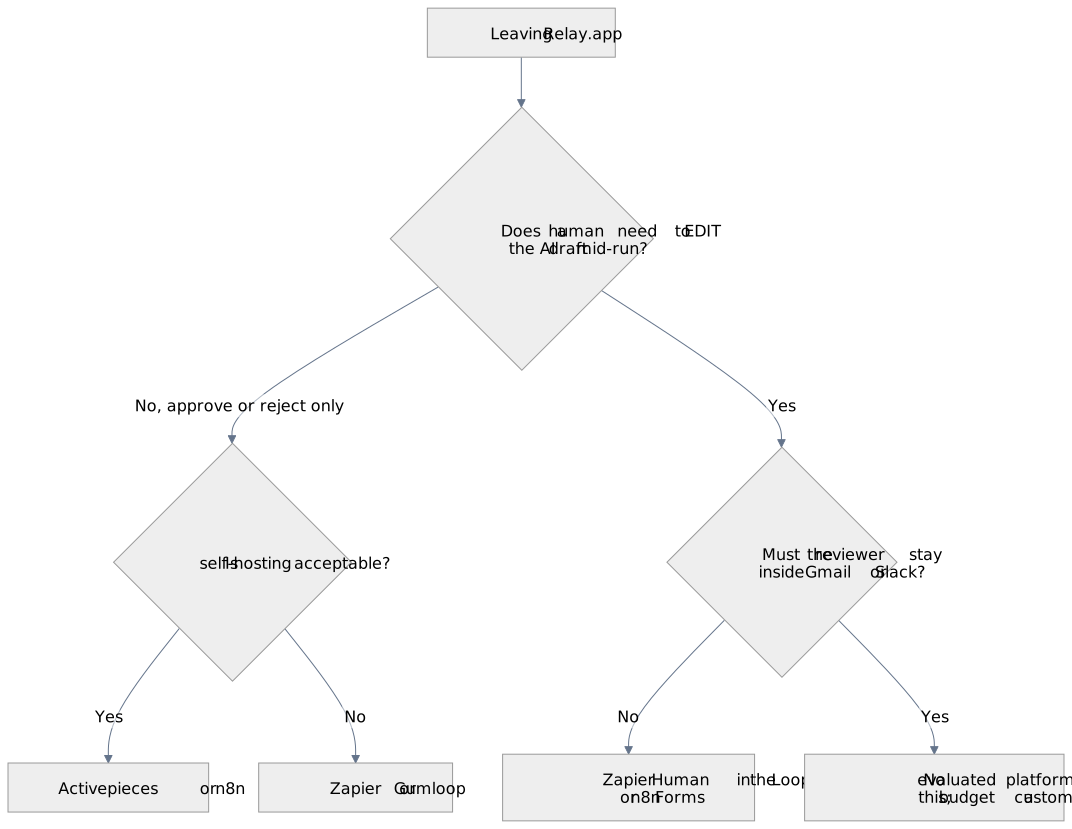
Diagram source (Mermaid)
flowchart TD
  A[Leaving Relay.app] --> B{Does a human need to EDIT the AI draft mid-run?}
  B -- No, approve or reject only --> C{Is self-hosting acceptable?}
  C -- Yes --> D[Activepieces or n8n]
  C -- No --> E[Zapier or Gumloop]
  B -- Yes --> F{Must the reviewer stay inside Gmail or Slack?}
  F -- No --> G[Zapier Human in the Loop, or n8n Forms]
  F -- Yes --> H[No evaluated platform does this; budget a custom form]
What Relay.app did not say
The notice runs to roughly 3,800 words including an eleven-question FAQ, covers billing, refunds, export and support in detail, and at no point gives a reason for the shutdown. No acquisition, acquihire or asset sale has been announced by Relay.app, by its founder, or by any acquirer, and the wind-down ends in permanent data deletion rather than a transfer. Any explanation currently circulating is inference.
One disambiguation, because it pollutes search results: this is Relay.app the AI workflow automation platform, unrelated to Relay for Reddit, a mobile client that shut down in 2023 for different reasons.
Editor's Note: We checked this against Relay.app's own pages rather than the competitor migration posts, and three things none of those posts mention are worth knowing. Relay.app's documentation site currently states the two deadlines the wrong way round, giving paid accounts the August date, and the error runs in the direction that loses data. The export has three limits that will catch people out: 24-hour generation, a 48-hour download link, and CSVs that truncate at 100,000 rows without warning. And Relay.app itself says the JSON export "won't work through their native importers", so the markdown build prompts are the migration vehicle, which is the opposite of what most migration advice assumes. On the destination question we have nothing to sell: the platform that most closely reproduces edit-in-the-loop is Zapier, and the price of that is your approvers logging into Zapier rather than replying where they already work. — Rafal Fila, ShadowGen
Related Questions
Related Tools
Relay.app
Shutting down: service ends 14 September 2026 (free tier ends 15 August). Was a workflow automation platform with human-in-the-loop approvals.
Workflow AutomationZapier
Automate workflows between apps without coding—connect 9,000+ tools with simple, reliable automation.
Workflow AutomationActivepieces
No-code workflow automation with self-hosting and AI-powered features
Workflow Automationn8n
Workflow automation for technical teams
Workflow AutomationRelated Rankings
Best Human-in-the-Loop Automation Platforms 2026
Eight platforms are ranked here on a single mechanism: how a person enters an automated path, and what the system can prove afterward about the decision they made. Moxo scores 7.7 and ranks first; Camunda 8 scores 7.2, Microsoft Power Automate 7.1, Pega 6.9, n8n 6.7, Zapier 5.9…
Best Automation Platforms for AI Orchestration 2026
This ranking answers one question: how many real business applications can an AI agent act on out of the box? It evaluates nine platforms as of August 2026 on the reach they give an agent, not on the workflow logic they can express. That boundary is deliberate, because two…
Dive Deeper
Moxo vs Gumloop in 2026: Texting the Client, or Building the Agent
Gumloop (founded 2023) builds AI agents a company's own staff run; Moxo, whose predecessor Moxtra was co-founded in 2012, runs processes that wait on people outside the company. Gumloop wins three rounds to two: the way in, per-tool gating and a priced overage. Moxo wins on…
Moxo vs Relay.app in 2026: Where Relay's Approval Workflows Can Go Next
Relay.app, founded in 2021, shut down in September 2026 and deleted every account, workflow and run history; Moxo, whose predecessor Moxtra was co-founded in 2012, is one destination for its human-in-the-loop users. Relay.app takes two rounds, Moxo one, and vendor risk is a draw…
Moxo vs Workato in 2026: The Integration Estate, or the Approval Inside It
Workato, founded in 2013, is an enterprise integration platform whose Workflow apps add human tasks to recipes; Moxo, whose predecessor Moxtra was co-founded in 2012, ships the human step itself. Workato wins three rounds to two: connector reach, change control and the way in…