Cline
by Cline
Open-source autonomous coding agent for VS Code with file editing, terminal commands, and bring-your-own-key model support. Cline (formerly Claude Dev) is an open-source AI coding agent that runs as a VS Code extension. It was first released in 2024 by Saoud Rizwan, is licensed Apache-2.
Key Facts
Pricing
| Attribute | Value | As of | Source |
|---|---|---|---|
| Real cost (API spend) | The extension is free; real cost is model API spend. Active daily use on Claude Sonnet commonly runs about $5-30 per developer per day, varying with task volume and model choice. | Jun 2026 | Cline pricing page |
| License & pricing (June 2026) | Free and open-source under Apache-2.0. Bring-your-own-key (pay model providers directly) by default; optional Cline-hosted pay-as-you-go inference credits (no subscription); Enterprise tier custom-priced with SSO, SLA, JetBrains extension. | Sep 2026 | Cline pricing page |
Adoption
| Attribute | Value | As of | Source |
|---|---|---|---|
| Install base | More than 1.5 million VS Code Marketplace installs by April 2026 and over 59,000 GitHub stars; among the most-installed agentic coding extensions, still growing as of June 2026. | Jun 2026 | Cline GitHub repository |
General
| Attribute | Value | As of | Source |
|---|---|---|---|
| Pricing | Free Apache-2.0 licensed extension; users pay model providers directly (BYOK) | Sep 2026 | Cline pricing page |
| Install Base | 4.7M+ VS Code Marketplace installs as of July 2026 | Jul 2026 | VS Code Marketplace |
| Released | 2024 (originally released as Claude Dev) | Apr 2026 | GitHub cline/cline |
| Key Differentiator | Open-source autonomous agent with human-in-the-loop checkpoints and MCP server support | Jul 2026 | Cline official site |
About Cline
Cline (formerly Claude Dev) is an open-source AI coding agent that runs as a VS Code extension. It was first released in 2024 by Saoud Rizwan, is licensed Apache-2.0 on GitHub at cline/cline, and passed 1.5 million VS Code Marketplace installs by April 2026 with more than 59,000 GitHub stars — among the most-installed agentic coding extensions.
The agent reads and edits files in the active workspace, runs terminal commands with explicit user approval, and works through multi-step tasks autonomously while pausing at human checkpoints. That human-in-the-loop approval model is Cline's defining trait: rather than applying changes silently, it proposes each file edit and command and waits for confirmation, which gives developers full visibility into what the agent is about to do.
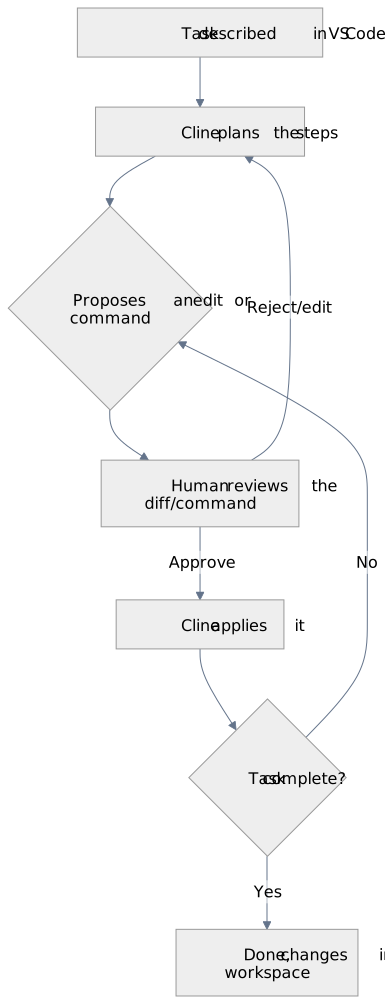
Diagram source (Mermaid)
flowchart TD
  A[Task described in VS Code] --> B[Cline plans the steps]
  B --> C{Proposes an edit or command}
  C --> D[Human reviews the diff/command]
  D -- Approve --> E[Cline applies it]
  D -- Reject/edit --> B
  E --> F{Task complete?}
  F -- No --> C
  F -- Yes --> G[Done, changes in workspace]
Cline is bring-your-own-key by default: developers connect their own Anthropic, OpenAI, OpenRouter, AWS Bedrock, Google Vertex, or Azure credentials and pay model providers directly, so the extension itself is free. As of 2026 Cline also offers an optional hosted path — pay-as-you-go AI-inference credits billed through Cline, with no subscription — for teams that prefer one bill over managing provider keys, plus an Enterprise tier (custom pricing) adding SSO, an SLA, dedicated support, and a JetBrains extension. The Model Context Protocol (MCP) framework lets Cline add custom tools for browsing, search, and external APIs. Cline suits developers who want transparency over every agent action and direct control of model spend; for active daily use on Claude Sonnet, real-world model cost commonly runs about $5-30 per day.
Editor's Note: We ran a head-to-head for a fintech client choosing between Cline and a subscription editor. Cline won on auditability — its approve-each-step model meant their senior engineers could veto risky terminal commands before they ran, which mattered for a regulated codebase. On spend, two developers using Claude Sonnet through their own Anthropic key cost roughly $24/day combined during an intensive sprint week, then dropped to near nothing on light weeks, which suited their variable workload better than a flat per-seat fee. The caveat: the approval prompts that make Cline safe also slow it down, so for low-risk boilerplate the developers switched to auto-approve to keep pace. — Rafal Fila, ShadowGen
Integrations (4)
Other AI Coding & Development Tools Tools
Aider
Open-source command-line AI pair programmer that edits Git repositories with multi-file context and automatic commits.
AI Coding & Development ToolsBolt.new
In-browser AI full-stack app builder running entirely on WebContainers, with no local environment setup.
AI Coding & Development ToolsChatGPT Codex
OpenAI's cloud-based autonomous coding agent integrated into ChatGPT
AI Coding & Development ToolsClaude Code
Anthropic's agentic CLI tool for AI-assisted coding and automation development
AI Coding & Development ToolsSee How It Ranks
Best AI App Builders in 2026
AI app builders are a 2024-2026 category of products that turn natural-language prompts into deployable web applications. The category emerged from the convergence of frontier LLM capability (Claude, GPT-4o, Gemini) and improved tooling for code generation, in-browser runtimes…
Best AI Coding Tools and Developer Assistants 2026
AI coding tools have become essential for professional developers in 2026, with the category spanning full AI-native editors, IDE plugins, terminal-based assistants, and code generation platforms. This ranking evaluates the leading AI coding tools based on code suggestion…
Questions About Cline
How much do AI coding assistants cost in 2026?
As of June 2026, mainstream AI coding assistants cluster in two cost shapes. Per-seat subscriptions with included AI usage: GitHub Copilot Pro $10/month (Business $19/seat), Cursor Pro $20/month, and Claude Code and ChatGPT Codex bundled into Claude ($20+) and ChatGPT ($20+)…
What are the best ChatGPT Codex alternatives in 2026?
As of April 2026, the leading ChatGPT Codex alternatives are Claude Code (terminal and IDE agent from Anthropic), Cursor (AI-first IDE with Composer), GitHub Copilot (Microsoft baseline with agent mode), Aider (open-source CLI for git-based edits), and Cline (open-source VS Code…
Is Aider worth it in 2026? A detailed review
Aider scores 7.6/10 in 2026. The Apache 2.0 CLI pair programmer by Paul Gauthier supports Claude, GPT-4, DeepSeek, Gemini, and local Ollama models with Git auto-commits and a public code-edit benchmark.
How much does Cline cost in 2026?
Cline is free and Apache-2.0 licensed; users pay model providers directly. Typical Claude Sonnet usage runs $5-$30/day for active developers as of April 2026.